Born without a left hand, Stephen Davies never found arm prosthetics especially helpful. In fact, he disliked both the functional design and the aesthetic of the arms he'd tried, calling one such device 'medieval torture.'
Enter Enabling the Future, a "global network of passionate volunteers using 3D printing to give the world a helping hand." Through that organization, volunteer Drew Murray created a hand for Steve using a 3D printer. Steve was delighted with the outcome.
So delighted in fact that he and Drew teamed up as Team UnLimbited. They do their own research and development, and then publicly share their discoveries and limb designs so people anywhere can reap the benefit. They have received thank yous and photos from amputees around the world, beaming about their newfound function with these inexpensive prosthetics.
The stories of children with missing limbs are especially close to Steve's heart. He remembers what it was like and does what he can to make a difference.
So now Steve has a backyard shed which houses his creation lab. In it, he uses a 3D printer to custom-make an arm for a specific child, using the child's choice of templates and colors. He has made Spider Man, Iron Man, Harry Potter, Lego, and a number of other designs, each created for a nominal cost of about 25 pounds (British.)
Even at that low price, the family is not charged for the arm. Team UnLimbited receives donations to offset the cost of materials; Steve donates his time and effort in exchange for the smiles.
Back in 1988, Zuo Hongyan gave birth to a son in her home province of Hubei, China. Birth complications led to the baby being diagnosed with cerebral palsy in infancy. Local doctors advised she give up the baby, as he would probably be disabled and/or have low intelligence. Her husband agreed, saying that the boy would be a burden on the family his entire life.
In order to support them both, Zou took a full-time job and several part time jobs too. In between, she took him to therapy and learned how to carry over some of the activities at home. She bought puzzles and brain teasers, massaged and stretched him, and insisted he learn to eat with chopsticks as was their custom. Her goal was to push her son as far as he could be pushed given his disability.
Zou's son Ding Zheng has done well indeed. He obtained a bachelor's degree from Peking University’s Environmental Science and Engineering School, and then enrolled in that university's International Law School. Last year, he began studies at Harvard University.
That's right. The Chinese baby who was to be 'given up' as a 'burden' now attends an Ivy League school in the US. All because someone believed he shouldn't be defined by his disability.
A blog post changed Annapolis Maryland photographer Stephanie Smith's business forever. It seems a family was scheduled for a shoot with an area photographer. A few days before the shoot, the mother contacted the photographer to firm up details. She told him that one of her children has Down Syndrome and may need a little extra time and patience. The photographer cancelled the shoot, stating that this was not his ideal client.
Stephanie was horrified, and decided to do something. She established Lenses for Love, which provides free photo shoots for families with a child who has special needs. Word spread and requests for Stephanie's services came in from around the country. A GoFundMe site was set up to help with costs involved in travel, props, etc. Better than that, other photographers from other regions joined Stephanie in offering the free shoot.
Thanks to them, precious moments with the whole family can be captured and cherished.
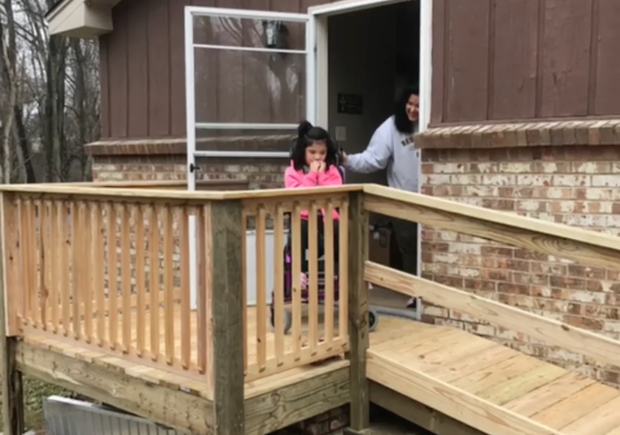
So late last month, Mitchell and four fellow volunteers built a new ramp for the DeSpain's home. Now Verna and Lydia can both be safe as they enter and exit their home.
Becky Large knows the struggles first-hand. Traveling and vacationing with a family member who is autistic, like her son Harley, is the complete opposite of relaxation. Airports and vacation spots are filled with sensory overload, which sends the person with autism into a meltdown.
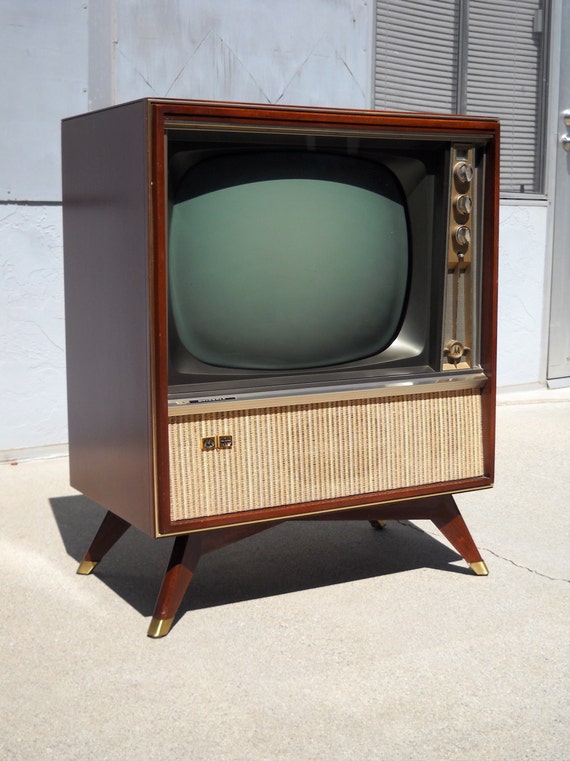
Amazing changes have occurred in my lifetime, changes in just about every aspect of daily life. When I was born, the minimum wage was $1 an hour. Our parents made us drink whole milk and eat liver because it was good for us. Smoking was considered chic, and cough medicine with codeine was available over the counter. We had no child car seats, and I don't think we had a car with a seatbelt until the early 1970s. Our family was like most - one black and white TV centrally located in the living room, which had to be shared by all family members. I could go on, but you get the idea.
I was recently reminded of just how different our society is another way - our attitude toward children with disabilities. I know something about this first hand. You see in 1958, my younger sister Joyce was born with hydrocephaly.
In those years before shunts were medically available to manage the excess cerebral spinal fluid, the parents were either (a) not told what might be wrong and the newborn was just sent home, or (b) told the child was hopelessly retarded (ah, terminology, another huge change in my lifetime) and should be institutionalized. That way, it was explained to the shocked parents, they could move on with life as if that child were never born.
If parents decided to raise the child at home as my parents did, God bless them, they got little or no support. Back then, many people believed that giving birth to a child with a disability was God's punishment for the parents' sins. There was no agency providing guidance or intervention, no child-sized adaptive equipment, no clinic or moms' groups giving support. My mom sewed together cloth diapers and rubber pants because incontinence care items for a child over preschool-age didn't exist. Even a basic right such as education was denied Joyce and others like her until the Education for All Handicapped Children Act (now known as Public Law 94-142) was passed in 1975.
Since Joyce didn't walk until she was 5 years old, we often brought her out into the community in an over-sized baby stroller. Yes, people stared and pointed and tsk-tsked, and adults pulled their children away as if Joyce had something contagious. And yes, all of that affected me, shaped me. I learned early on how to speak my mind, and for good or bad, I've been that way all my life.
But the point is this - in the last 50+ years, our society has learned how to accept children with disabilites and support them and their families with appropriate programs, therapies, and education. Not necessarily embrace them, mind you, but accept them for what they are, loving and love-worthy human beings endowed by their Creator with the same inalienable rights as everyone else.
This video is a prime example of that positive change. We're not yet where we need to be, but with every passing decade, we're getting closer.
If you love a child with a disability, give a prayer of thanks for folks like my parents, Joyce, and the generations who struggled and lived happy lives with the people they loved, regardless of what their doctors and their society said.
 Born without a left hand, Stephen Davies never found arm prosthetics especially helpful. In fact, he disliked both the functional design and the aesthetic of the arms he'd tried, calling one such device 'medieval torture.'
 So delighted in fact that he and Drew teamed up as Team UnLimbited. They do their own research and development, and then publicly share their discoveries and limb designs so people anywhere can reap the benefit. They have received thank yous and photos from amputees around the world, beaming about their newfound function with these inexpensive prosthetics.
 So now Steve has a backyard shed which houses his creation lab. In it, he uses a 3D printer to custom-make an arm for a specific child, using the child's choice of templates and colors. He has made Spider Man, Iron Man, Harry Potter, Lego, and a number of other designs, each created for a nominal cost of about 25 pounds (British.)