Showing posts with label learning from history. Show all posts

Sunday, November 27, 2016

The little known Sharp's War

I've read a lot of Nazi-era history in the last 10 years, both fiction and non-fiction. Sometimes I think I've heard it all before. Then I stumble across a story of people who did right in the face of that evil, a tale of personal sacrifice and courage which seems to be forgotten by history. The story of an American couple, Waitstill and Martha Sharp, falls into that group.

In 1938, Waistill Sharp was a Unitarian minister in Massachusetts. He and his wife Martha, a social worker, had a full, busy life caring for their congregation and their community, as well as their own two young children. One night, Waistill received a call from Robert Dexter, the director the Department of Social Relations of the American Unitarian Association. The newly signed Munich Accord gave Hitler control of the Sudetenland. This piece of Czechoslovakia had strong ties to the Unitarian Church, and as Dexter recalled later, “I knew there would be untold suffering in the Nazi-occupied territories, and I was equally convinced that something should be done about it by those of us who felt we had an obligation to aid our friends who had been so betrayed.”


Seventeen people had already turned down Dexter's request for someone on the ground in Europe. Waistill and Martha talked about it and agreed. They'd go to Europe and do what they could.

So in February 1939, the Sharps traveled to occupied Czechoslovakia and later to occupied France. They stayed one step ahead of the Nazis to rescue dozens of at-risk Czechs and get them abroad. Later, they returned to Europe and shepherded people out of occupied France to safety and transport via Lisbon. The number of people saved by their efforts is unknown, in part because they destroyed all records of their travels and those involved. The estimate is in the hundreds. Because their efforts included Jews, the Sharps were posthumously awarded The Righteous Among the Nations by Yad Vashem. 


A new PBS documentary by Ken Burns starring the voices of Tom Hanks and Marina Goldman now shares the Sharp's story with the world. 


Monday, October 13, 2014

What I thought I knew

An old PBS radio show featuring Paul Harvey was called "The Rest of the Story". In it, he added little known facts and unexpected connections to tales we thought we knew and understood. That show came to mind this week while reading "America's Hidden History" by Kenneth C. Davis, a "Rest of the Story" type book chock full of honest truths about America's roots. Some of those truths are relevant for today, the day in which we Americans celebrate Columbus' landing in this new world.

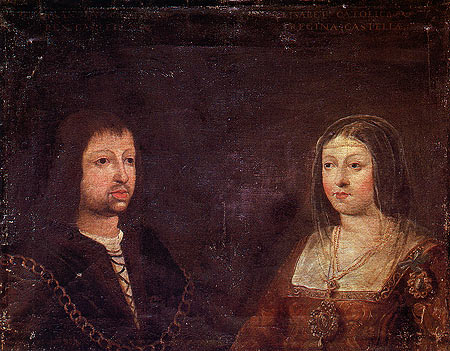
Remember Queen Isabella and King Ferdinand of Spain, the ones who bankrolled Columbus' voyage? In my elementary school textbooks, they were portrayed as people who saw the potential in his exploration, no doubt with the possibilities of expanding their own kingdom's reach and power. For a king and queen, good guys.

Or so I thought.

Turns out that they were staunch Roman Catholics and the force behind the horrific Spanish Inquisition. During their reign, Muslims and Jews of Spain were removed from Spain, either by force or by death. Genocide was the fate for all who did not follow Catholicism. Interestingly, Isabella and Ferdinand's daughter, Catherine of Aragon, later became the wife of England's Henry the Eighth. Yikes.

On one of Columbus' later journeys back to America, Queen Isabella suggested he bring pigs on board. The pigs were meant to provide food for the long voyage as well as the beginnings of a conventional European-style farm in the new world. Ends up the pigs brought more than food to these shores. The diseases the pigs harbored, to which the sailors were apparently immune, devastated the nearby Native American population. For the Native Americans, it was clear that these new residents brought nothing but trouble. Not a good tone to set for future relations.

The more I learn, the less I know.
I love that.


Sunday, September 21, 2014

What would I do?

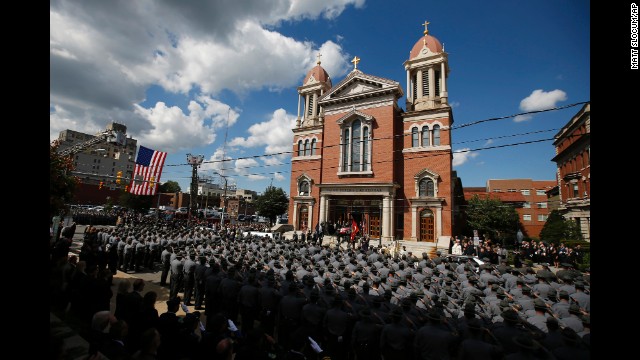
Our rural, ordinarily quiet region of Pennsylvania suffered the loss of a state trooper and the injury of a second trooper in an ambush at their barracks. As I write this, the gunman with a grudge against law enforcement is still on the loose, reportedly on foot through the woods and back roads of the Pocono Mountains. With troopers closing in on all sides, I pray this will end soon and with no further harm to anyone.

On Thursday, the day of the trooper's funeral, hundreds of troopers from around the country attended.
To say security was tight is an understatement. So when I heard a low-flying helicopter overhead while I was at work, it barely registered. I assumed it was in connection with the funeral. Then I heard another helicopter. And another. The sound of blades became almost constant for about 20 minutes, and yet we were a full 12 miles away from the site of the mass and the burial. My thoughts switched. I began to wonder if the helicopters were searching the woods near my workplace for this madman.

Now I'm a fairly clear-headed person, not prone to panic or worst-case scenarios so I checked out news sources. The helicopters were indeed part of the funeral and the air search remained focused on an area about 30 miles away from me. But it made me wonder - if I had to live with a threat like that, how would I react? What would I do?

Which brings me to the point. In my safe, ordinary life, my behavior may be rational and predictable. If I were confronted with danger, I'd like to think I'd be moral. But I wonder. Would I freeze or act? Would I stay and fight or run? What if that danger surrounded me for days, for weeks or years? Would I hunker down in survival mode, or would I act to fight the danger which was disrupting my life and that of others?

That's where stories come in. Tales of people who behave honorably in horrific times and places continue to amaze me. Just this week I watched The Scarlet and the Black with Gregory Peck and Christopher Plummer. It's the true story of an Irish priest who worked at the Vatican during the Nazi occupation of Rome. He behaved honorably and according to his own morals in the face of Nazi aggression and against the orders of his Pope.

His tale gives me hope that, in the face of such evil, I would behave honorably too. 


Sunday, August 31, 2014

Politically incorrect for a reason

A disclaimer: Please read this blog all the way to the end. Please don't pull an excerpt out of context and let it go viral. 

From the time our country was founded, it was destined for greatness. We have given birth to great minds in science and medicine, musical geniuses, champions of business, world-class athletes, inventors and innovators. We are a strong people, hard-working and proud of who we are and what we have accomplished. The world is a better, more productive place because of us. 
In this last generation, we have been demoralized. Our economy has tanked. Jobless rates are up. Cost of living has skyrocketed. Our infrastructure of roads and bridges is failing. Twenty years ago, we were a global power. Now we are struggling. And our current government has not addressed these problems to our satisfaction.

Most of us work hard and care for ourselves and our families. We contribute to our community and nation through taxes and volunteer work, knowing full well that we all must do our part and pay our fair share.

Yet some people sit around and do nothing. They are happy to sap our country's resources and collect from the public coffers without contributing to our nation's economic growth. They want what our nation has to offer: good medical care, decent housing, and schooling for their children. They are lazy. They hoard their possessions and won't pay their fair share of taxes as part of the people. They want something for nothing.

They are not like us, our nation of family-loving, self-sufficient people. So are they really part of us? Or are they subversive outsiders, pushing themselves into our country, trying to blend in while they drain our resources? 

Sound familiar? If we are honest with ourselves, most of us either have had thoughts like those, however fleeting, or have overheard someone voicing something similar about illegal immigrants, unaccompanied minors crossing the border in Mexico, folks on public assistance, etc. As rational adults, we know the problems are complex; there are no easy answers.

Because of the research I've done (and continue to do) into Nazi Germany, I can tell you - this is just the type of coercion Adolf Hitler used get into power in the early 1930s. Half-truths, exaggerations, and generalizations were used to get a people to fall in line, like citizens of Hamelin behind the Pied Piper.
Tolerance of this type of outburst created a dictatorship. That dictatorship created laws, which led to pursuit of world dominance and a war which cost tens of millions of lives.

What have we learned? Our lesson ought to be to not blindly follow the masses.

Through sticky situations like unaccompanied minors and long-term use of public assistance, we must proceed with eyes and minds wide open. We need to think for ourselves and propose creative solutions, independent of what the media, our friends, and popular opinion say.
If we've truly learned the lessons of history, we have an obligation to speak against outbursts like the one above. Otherwise we're at the top of a slippery slope, a position we should know to avoid.