This episode highlights Nazi aggression toward people of Jewish heritage and the resulting international effort to rescue vulnerable children.
Showing posts with label Nazi Germany. Show all posts
Showing posts with label Nazi Germany. Show all posts
Monday, May 20, 2019
Episode 8, Kristallnacht and the Kindertransport
Last of my series called 'Why I wrote novels set in Nazi Germany.'
This episode highlights Nazi aggression toward people of Jewish heritage and the resulting international effort to rescue vulnerable children.
This episode highlights Nazi aggression toward people of Jewish heritage and the resulting international effort to rescue vulnerable children.


Friday, March 29, 2019
Episode 7, propaganda
The Nazis didn't corner the market on biased information, but they utilized it in every facet of German life to foster their own aims. Watch and learn. And share this with others.
Tuesday, February 12, 2019
Goodreads giveaway and a fourth video
Enter on Goodreads for a chance to win one of 100 Kindle copies of The Path Divided, the 'must-read' conclusion of the story that began in Risking Exposure!
The fourth in my 'Why I wrote novels set in Nazi Germany' video series is live on YouTube. Or you can watch it here:
The fourth in my 'Why I wrote novels set in Nazi Germany' video series is live on YouTube. Or you can watch it here:
Tuesday, January 22, 2019
Why I wrote novels set in Nazi Germany, #3
This video digs a bit more into the T4 pogrom and Nazi propaganda.
Sunday, January 6, 2019
Sunday, December 30, 2018
Beginning a video series

This is the first of what I hope will be a series of videos (available here and on YouTube) explaining why 'a nice lady' would write novels set in Nazi Germany. Enjoy!
Friday, November 9, 2018
Have we forgotten?
Today marks the 80th anniversary of Kristallnacht, The Night of Broken Glass. It was the Nazi's first widespread pogrom of physical aggression against the Jewish people in Germany and its occupied lands. If you want details about how and why it happened, the USHMM website is a marvelous resource.
The government sanctioned the action. People were beaten, arrested, and killed. Synagogues were burned, Torahs were desecrated, businesses were destroyed. Lives were shattered. After Kristallnacht, no one could doubt the Nazi's intentions toward the Jewish people.
In researching my (soon-to-be-released, I promise!) novel, The Path Divided, I interviewed a Jewish woman who lived in Munich in 1938. Her memories of that day are so vivid, I'll just paste them here.
I asked her about the mood in her neighborhood in the days after Kristallnacht.
As the recent shooting in Pittsburgh's Tree of Life Synagogue shows, antisemitism still exists. My prayer this day is that we NEVER passively accept aggression against ANY group of people.

The government sanctioned the action. People were beaten, arrested, and killed. Synagogues were burned, Torahs were desecrated, businesses were destroyed. Lives were shattered. After Kristallnacht, no one could doubt the Nazi's intentions toward the Jewish people.
In researching my (soon-to-be-released, I promise!) novel, The Path Divided, I interviewed a Jewish woman who lived in Munich in 1938. Her memories of that day are so vivid, I'll just paste them here.
"It happened to be the Yahrzeit of my father’s Mum, I think, so he went to the synagogue that morning. It was actually a little prayer hall as the Nazis had previously destroyed our big synagogue.Someone phoned our flat early on 9 November and told my Mum (who never found out who it was that called) to get out of Munich - they were arresting all Jewish males. My mother told my brother and me not to go to school/college that day and we would find our Dad at the synagogue. But when we got there in our little Opel Olympia car, we saw an SS man standing guard.

"My mum had got out of the car well before we got there and my brother and I saw her talk to this SS chap and then walk away in the opposite direction of the car. My brother, aged 17 who’d never had a driving lesson, bravely drove slowly along the pavement till we caught up with my Mum who indicated that he should drive round the next corner. He did, my Mum got in and, just on the off-chance of finding my Dad in his office, we drove there.
"We saw the shattered glass of Jewish shop windows as we parked the car. My Mum went up and we waited, then my brother went up and after a while they came down. My brother went to his college, my Dad had a valid passport on him and went to his sister in Luxemburg and my Mum and I went to my grandmother’s house.
"My brother came there a bit later as he realised it wasn’t safe for him at his college.
"I never went back to school until I got to England in 1939."
I asked her about the mood in her neighborhood in the days after Kristallnacht.
"Incredulity and embarrassment on the part of our non-Jewish friends and neighbours. But also a sort of passive acceptance of what the Nazis did."
As the recent shooting in Pittsburgh's Tree of Life Synagogue shows, antisemitism still exists. My prayer this day is that we NEVER passively accept aggression against ANY group of people.
We must stand against any government or ideology that tries to divide us into US vs THEM.
WE MUST NEVER FORGET.

Tuesday, June 19, 2018
Immigrant children: a lesson in compassion from yesteryear
With our nation's current attention on caring for immigrant children, I'd like to highlight a shining example of compassion toward minors during a time far more horrific than our own.
In early November, 1938, the Nazis unleashed their fury on the minority Jewish population of Germany. Synagogues were burned, homes and businesses were looted and destroyed, men and rabbis were dragged from their beds and beaten in the streets. People died and thousands were arrested across the country, sent to prison or 'work camps.' If Jewish Germans had not realized the extent of the threat to their safety before that night, called Kristallnacht or 'Night of Broken Glass,' that night of terror was their wake up call. The following days saw huge lines at emigration offices.
Meanwhile in England, social welfare agencies, some Jewish, some not, scrambled to come up with a plan to help. The prevailing thought was this: in England and in most other nations, immigration laws mandated the emigrating adult to have a job and housing promised upon arrival. Children had no such mandate. So why not allow vulnerable children to leave Germany and live in host homes until their parents could join them?

By early December, the first Kindertransport had been funded through donations, organized and staffed by agency employees and volunteers, and was underway. The Kindertransport was not only legal, it was created by cooperative efforts of the Nazi Party, Parliament, and a number of social welfare agencies and churches. Between December 1938 and September 1939, almost 10,000 children, mostly Jewish, left Germany and occupied countries for resettlement, mostly in the UK and Scandinavia.

The children's parents typically filed to emigrate to the same country as their children, but not many made it before war broke out in September 1939. Then both the borders and the adults' fate were sealed.
History has provided us with this wonderful example of governments and nonprofits working together to protect children. I was honored to interview a former 'Kinder' as I researched The Path Divided, and I will never forget her story. My question is - what are we doing today to protect those who are equally vulnerable?
Friday, November 24, 2017
Anonymous donor tracked down decades later - and a scholarship is founded in her name
Hilde Back knows the power of spreading kindness. As youngsters, she and her brothers had fled Nazi Germany for Sweden. Their parents perished in the camps. Hilde has never forgotten the warm welcome the children received as strangers in Sweden and the opportunities they were given to create a new life there.
She was teaching preschool several decades later when she heard about a program her school's administrator was starting. It would fund primary and secondary education for gifted children in Nairobi. Hilde jumped at the chance to give this opportunity to a stranger in a land she'd never visited. All she learned about the child was this: His name was Chris. He was 5 or 6 years old. His older sister wrote a few letters to Hilde, then those petered out. She kept up her contributions anyway.
 Fast forward to 2002. The Swedish Ambassador in Nairobi contacted 80-year-old Hilde. The child she sponsored all those years ago wanted to meet his patron to say thank you. Chris Mburu had earned degrees from the University of Nairobi and Harvard Law School and worked for the United Nations as a Human Rights Advisor. The two met, and not surprisingly, they got along well.

Hilde and Chris have met a number of times since. A documentary about Hilde and Chris' story called A Small Act aired on HBO in 2010, and won awards at various film festivals.
In tribute to Hilde's kindness and to continue its spread, Mburu started a scholarship in her name. Hilde has flown to Kenya to visit Chris and to personally see the effect this fund has on the students it supports. To date, 673 scholarships have been awarded to sponsor education for children in Kenya. All because Hilde decided to pass it on.
Friday, September 8, 2017
LOC research day
In an effort to accurately portray era events in my novel-in-progress, I spent Wednesday conducting research at the Library of Congress in Washington DC. What a treasure trove we Americans have at our disposal - all open and free for the asking.
Beginning a couple weeks ago, I spent hours on the LOC website, scouring their archive. Some documents and images I was interested in were readily available on their website, while others were identified as 'available on site' at the LOC. For those items, I jotted down LOT numbers and contacted librarians in the Photographs room and Newspapers room by email and gave them the date of my planned visit. Within 24 hours, they responded to let me know the items were available and would be waiting for me upon arrival. And they were.
In one (very) long day, I saved over 300 images and newspaper articles onto my memory stick. Obviously I haven't had time to sift through them all, but some of my amazing preliminary finds include:
1. A private photo album of a Lebensborn home in Steinhoring, near Munich;

2. Two full-sized Nazi propaganda posters;


3. The apparent lack of any mention of the events of Kristallnacht in the Munich newspaper in the days following the violence.

In contrast, the New York Times was chock full of articles, op-eds, and letters to the editor for days.
Talk about the value of free press. Wow.

After I sift through the overwhelming volume of material obtained, I'll integrate relevant details and facts into my story's backdrop. My hope is to accurately portray what it must have been like to be 15 years old in Munich in 1938.
Sunday, November 27, 2016
The little known Sharp's War
 I've read a lot of Nazi-era history in the last 10 years, both fiction and non-fiction. Sometimes I think I've heard it all before. Then I stumble across a story of people who did right in the face of that evil, a tale of personal sacrifice and courage which seems to be forgotten by history. The story of an American couple, Waitstill and Martha Sharp, falls into that group.
 In 1938, Waistill Sharp was a Unitarian minister in Massachusetts. He and his wife Martha, a social worker, had a full, busy life caring for their congregation and their community, as well as their own two young children. One night, Waistill received a call from Robert Dexter, the director the Department of Social Relations of the American Unitarian Association. The newly signed Munich Accord gave Hitler control of the Sudetenland. This piece of Czechoslovakia had strong ties to the Unitarian Church, and as Dexter recalled later, “I knew there would be untold suffering in the Nazi-occupied territories, and I was equally convinced that something should be done about it by those of us who felt we had an obligation to aid our friends who had been so betrayed.”
Seventeen people had already turned down Dexter's request for someone on the ground in Europe. Waistill and Martha talked about it and agreed. They'd go to Europe and do what they could.
So in February 1939, the Sharps traveled to occupied Czechoslovakia and later to occupied France. They stayed one step ahead of the Nazis to rescue dozens of at-risk Czechs and get them abroad. Later, they returned to Europe and shepherded people out of occupied France to safety and transport via Lisbon. The number of people saved by their efforts is unknown, in part because they destroyed all records of their travels and those involved. The estimate is in the hundreds. Because their efforts included Jews, the Sharps were posthumously awarded The Righteous Among the Nations by Yad Vashem.

Saturday, November 5, 2016
One doctor's ingenious fake epidemic
 When the Nazis moved into Poland in 1939, Eugene Lazowski had just finished medical school. He was made an officer in the Polish army and stationed in the town of Rozwadow where he worked for the Red Cross. The fence which marked the border of the town's Jewish ghetto was right behind his house.
Dr. Lazowski had heard of recent discoveries by fellow Pole Dr. Stanislaw Matulewicz. It seems that a certain strain of the typhus bacteria, when killed and injected, will allow the patient to test positive for the deadly epidemic disease while remaining symptom-free. Dr. Lazowski tried it, and sent the patient's blood sample to a German lab for testing.
The response was a red telegram - the patient has epidemic typhus and must be quarantined.
The patient was not ill.
So Dr. Lazoswki came up with a plan. Whenever a patient came to him, be it a villager or a Jew from the ghetto (who he was forbidden to treat but did so anyway), he injected them with the bacteria. Blood samples left the village, red telegrams returned.
 Soon the village and the ghetto seemed to be a hotbed of epidemic typhus. Nazis avoided the area - Germany had not had an outbreak of typhus in a generation, and officials worried about their soldiers' vulnerability. When a medical inspection team was sent to check on the epidemic's status, Dr. Lazowski planted ragged, dirty villagers in the hospital. The nervous doctors took one look and left quickly. The village quarantine was official.
The Nazis stayed away from Rozwadow for the duration of the war. Over 8,000 villagers and ghetto residents were spared the fate of other Polish villages, all because of one doctor's kind heart and his ingenuity.
Thursday, July 21, 2016
Nicholas Winton, Or how an unmarried stockbroker rescued hundreds of foreign children
Last night, Michael and I watched Nicky's Family on DVD (thank you, Netflix.) It was the story of Nicholas Winton and the lasting effect of his pre-WWII efforts.
Back in December 1938, British-born Nicholas was packing for a ski trip to Switzerland when a friend named Martin Blake called and asked to meet him in Prague instead. Martin was involved in with the British Committee for Refugees from Czechoslovakia and needed Nicholas' help in figuring out how best to aid Czech people fleeing the German annexation of the Sudetenland. So, the ski trip was off.
 Nicholas was moved by the plight of these displaced Czech people, their desperation. They expected that war would soon be upon them, and young parents were understandably anxious about the safety of their children. Using Martin's contacts and then establishing his own official network (including a spy and some fake documents and rubber stamping), Nicholas created the pipeline called the Czech Kindertransport which functioned until the Nazis shut it down at the start of war on Sept. 1, 1939. His work resulted in 669 Czech children, mostly Jewish, being transported safely by rail and boat to England and placed with British families for the duration of the war.
Many of the parents who sent their children off to the homes of foreign strangers themselves perished in the war and the Holocaust. It is therefore believed that Nicholas' program saved the lives of those 669 children.
A humble man, Nicholas never spoke of his efforts afterward. It wasn't until 1988 that his wife discovered a scrapbook he kept with photos and names of each of the children. She led the effort to contact these now-grown children and organized the first of many 'family' reunions. When he died at age 106, Nicholas' 'family' had grown to a world-wide, multi-generation family well over 5000 strong.
All because one man decided to do One Right Thing.
Monday, July 18, 2016
Bookworm for kids blog
This morning, I'll share a different kind of positive story. The blog Bookworm for Kids has posted a review of my historical fiction novel Risking Exposure. To say I'm thrilled with the review is an understatement! The blog's author has even included my book as one of her favorites for 2016.

Encouragement like this keeps me slogging through my two main challenges in writing: the way I get lost in research and my difficulty in taming endless ideas into a single coherent story shape. Thanks for the motivation, Tonja Drecker!
Encouragement like this keeps me slogging through my two main challenges in writing: the way I get lost in research and my difficulty in taming endless ideas into a single coherent story shape. Thanks for the motivation, Tonja Drecker!
Sunday, March 15, 2015
Father Rupert Mayer


 So when we came across the Burgersaal Church with its relatively plain exterior, we followed the stream of tourists and entered, expecting a relatively plain interior to match. We couldn't have been more wrong. The ceiling frescoes were stunning.

Just as surprising was a display in the church detailing the life and ministry of a person I'd never heard of, Father Rupert Mayer. He was a Jesuit priest who served the Burgersaal Church between the two World Wars. His dedication to the poor and estranged of Munich earned him the nickname "The Apostle of Munich." Were he a man of lesser convictions during those times, his legacy may have ended there - a gentle priest who worked tirelessly to feed and clothe the poor.
But Father Mayer was a man of strong convictions, strong faith in his Catholic beliefs, and an insistence on the rights and dignity of each individual as a child of God. The Nazi regime with its oppression of free speech, its targeted pogroms, and its intolerance for faith-based viewpoints was unbearable for Father Mayer. He preached against the Nazis from the pulpit, in individual meetings with parishioners, and when he led small study groups.
Warned several times by the Gestapo and twice arrested for his outspoken behavior, Father Mayer might have ended up as other Christians did during the Nazi years - a martyr for his faith. But the Nazis saw the strong support Father Mayer had in mostly Catholic Munich, his leagues of dedicated parishioners and how word of his work had spread through Bavaria. They feared that killing him would only strengthen his cause. Instead, they banished him to an Abbey where he was basically a silenced prisoner for the duration of the war.
I never heard of Father Mayer before I stepped into the Burgersaal that day. Since then, I've come across his name dozens of times during the research for my two historical fiction novels set in Nazi-era Munich. Since he was so integral to the people of Munich during that time period, I'm considering including his character in my current Work In Progress.
Father Mayer was beatified in 1987 and now has the title of Blessed. His story has been made into a 2014 film starring Stacy Keach and Darryl Hannah. I hope to find it soon on Netflix or at a Film Festival near me.
Tuesday, December 30, 2014
Last post of 2014!
As I actively work on the research and writing involved in the sequel to Risking Exposure, I'm also trying to keep up this blog, my website, marketing, presentations - oh, and a job and family and a house and LIFE!
 So please excuse me if I've been off-schedule on posting here.
Today, I took some time to add a slide show to my website. It features photos Katie and I shot during the research trip to Munich. Each slide is captioned with either bits of history or personal thoughts. So check it out!
Hopefully I'll get back to Germany again. I'd like to check out specifics on the locations I'm using in the sequel, in person. Then I can share more pictures with all of you!
Best wishes for 2015.
Sunday, September 21, 2014
What would I do?
Our rural, ordinarily quiet region of Pennsylvania suffered the loss of a state trooper and the injury of a second trooper in an ambush at their barracks. As I write this, the gunman with a grudge against law enforcement is still on the loose, reportedly on foot through the woods and back roads of the Pocono Mountains. With troopers closing in on all sides, I pray this will end soon and with no further harm to anyone.
On Thursday, the day of the trooper's funeral, hundreds of troopers from around the country attended.
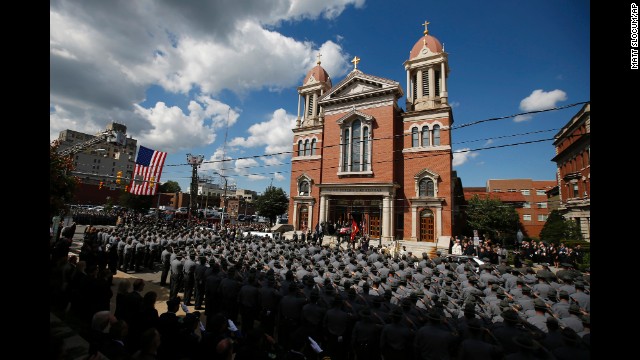 To say security was tight is an understatement. So when I heard a low-flying helicopter overhead while I was at work, it barely registered. I assumed it was in connection with the funeral. Then I heard another helicopter. And another. The sound of blades became almost constant for about 20 minutes, and yet we were a full 12 miles away from the site of the mass and the burial. My thoughts switched. I began to wonder if the helicopters were searching the woods near my workplace for this madman.
 Now I'm a fairly clear-headed person, not prone to panic or worst-case scenarios so I checked out news sources. The helicopters were indeed part of the funeral and the air search remained focused on an area about 30 miles away from me. But it made me wonder - if I had to live with a threat like that, how would I react? What would I do?
Which brings me to the point. In my safe, ordinary life, my behavior may be rational and predictable. If I were confronted with danger, I'd like to think I'd be moral. But I wonder. Would I freeze or act? Would I stay and fight or run? What if that danger surrounded me for days, for weeks or years? Would I hunker down in survival mode, or would I act to fight the danger which was disrupting my life and that of others?
That's where stories come in. Tales of people who behave honorably in horrific times and places continue to amaze me. Just this week I watched The Scarlet and the Black with Gregory Peck and Christopher Plummer. It's the true story of an Irish priest who worked at the Vatican during the Nazi occupation of Rome. He behaved honorably and according to his own morals in the face of Nazi aggression and against the orders of his Pope.
His tale gives me hope that, in the face of such evil, I would behave honorably too.
On Thursday, the day of the trooper's funeral, hundreds of troopers from around the country attended.
To say security was tight is an understatement. So when I heard a low-flying helicopter overhead while I was at work, it barely registered. I assumed it was in connection with the funeral. Then I heard another helicopter. And another. The sound of blades became almost constant for about 20 minutes, and yet we were a full 12 miles away from the site of the mass and the burial. My thoughts switched. I began to wonder if the helicopters were searching the woods near my workplace for this madman.Which brings me to the point. In my safe, ordinary life, my behavior may be rational and predictable. If I were confronted with danger, I'd like to think I'd be moral. But I wonder. Would I freeze or act? Would I stay and fight or run? What if that danger surrounded me for days, for weeks or years? Would I hunker down in survival mode, or would I act to fight the danger which was disrupting my life and that of others?
That's where stories come in. Tales of people who behave honorably in horrific times and places continue to amaze me. Just this week I watched The Scarlet and the Black with Gregory Peck and Christopher Plummer. It's the true story of an Irish priest who worked at the Vatican during the Nazi occupation of Rome. He behaved honorably and according to his own morals in the face of Nazi aggression and against the orders of his Pope.
His tale gives me hope that, in the face of such evil, I would behave honorably too.
Sunday, September 7, 2014
76 years ago today...
 ...the huge annual meeting of the Nazi Party known as the Nuremberg Rally was underway in the beautiful medieval city of Nuremberg, Germany.The scale of the undertaking was unbelievable, similar to modern cities hosting Olympic games - building huge stadiums, figuring out logistics of feeding, housing, and moving tens of thousands of people in a short period of time. I've been researching that week-long Rally for the scene I'm writing. Here's just a few things I've learned -
-first and foremost- the entire event was propaganda designed to awe participants. Its massive scale, its high energy, its show of unity and strength gave people the sense that they were witnesses to something grand and glorious. Brainwashing at its finest.
- upwards of a million people descended on the city for part or all of the Rally
- local hotels and pensions (guesthouses) filled up quickly with Nazi Party officials and SS. Many local citizens offered Rally participants a place to sleep in their homes
-the Rally began with a five-hour long parade through the city
-the Rally grounds occupied an 11 square km area. An existing soccer stadium, community hall, and war memorial were re-purposed by the Nazis. Construction of several new stadiums and parade grounds began almost immediately after the Nazis came into power in 1933 and continued until halted by the war.
 -one completed structure known as the Zeppelin field had a grandstand that held 50,000 people. The spectator stands and parade grounds below held another 150,000 people.
-a favorite event at the Zeppelin field was the nighttime torchlight parade. Over 100 searchlights at the stadium's perimeter pointed skyward, creating an effect that American journalist William Shirer called 'a cathedral of light.'
 -the Great Street was built to act as a central axis to the grounds.This 60 meter wide, 2000 meter long walkway created a parade route between key sites. Photo ops abounded.
Not hard for me to see how my character, a 14-year-old girl, would be caught up.
Read more about the Nuremberg Rallies.
The Third Rech in Ruins
Nuremberg Museum and Documentation Centre
US Memorial Holocaust Museum
Sunday, May 4, 2014
The most frequent questions, Pt. 3
Will there be a sequel to Risking Exposure? What are you writing now?
 When I finished writing Risking Exposure, I was tired. I had spent several years reading everything I could get my hands on about the Nazi era, watching documentaries, etc. Pouring through so much twisting of the truth and outright evil was exhausting, physically, emotionally, and spiritually. My conclusion was that I never wanted to read another thing about Nazi Germany ever again.
But within 6 or 8 weeks, something happened. I'd be driving down the road and a character I'd relegated to the 'deleted scenes' folder would pop into my mind. Something a neighbor said would remind me of a dialogue exchange I'd cut. Pretty soon those characters and exchanges were forming new scenes and it became clear - the characters in my deleted scenes folder wanted their story told too. It's my job to give them their opportunity.
 What is taking shape is a sequel, although told through another character's POV. No, I don't have a title or a time frame for release. That's actually not even on my radar yet.
I've been researching events which took place in Munich during July 1938 until very early 1939, about 6 months after Risking Exposure ends. I have what I believe to be a framework on which to hang my story. In my over-ambitious mind, I have set a goal of getting a first draft written by the end of 2014. (I may kick myself for making that public.)
When I finished writing Risking Exposure, I was tired. I had spent several years reading everything I could get my hands on about the Nazi era, watching documentaries, etc. Pouring through so much twisting of the truth and outright evil was exhausting, physically, emotionally, and spiritually. My conclusion was that I never wanted to read another thing about Nazi Germany ever again.But within 6 or 8 weeks, something happened. I'd be driving down the road and a character I'd relegated to the 'deleted scenes' folder would pop into my mind. Something a neighbor said would remind me of a dialogue exchange I'd cut. Pretty soon those characters and exchanges were forming new scenes and it became clear - the characters in my deleted scenes folder wanted their story told too. It's my job to give them their opportunity.
I've been researching events which took place in Munich during July 1938 until very early 1939, about 6 months after Risking Exposure ends. I have what I believe to be a framework on which to hang my story. In my over-ambitious mind, I have set a goal of getting a first draft written by the end of 2014. (I may kick myself for making that public.)
Sunday, April 27, 2014
The most frequent questions, Pt. 2
Why would a nice person like you write about Nazi Germany?
I've written (and published) fiction and non-fiction short pieces for all ages, preschool through adult. Risking Exposure is the only one set in Nazi Germany. The others aren't even remotely similar in time or place or even in tone - Chicken Soup for the Soul for audiences seeking inspiration, Highlights High Five for preschoolers, Advance for Physical Therapists for PTs and PTAs, Discovery Years and Thriving Family for parents, Hopscotch for kids, plus a few currently on Wattpad. I think across genres, I read across genres, so I write across genres too.
I love stories, real or fictional, in which an unlikely hero must pull himself up by his bootstraps and become more than he was, in which an ordinary person is forced to rise above her circumstances in order to stand up for what is right.
That means the hero would have to be in a time and place in which doing what's right comes at great personal risk. Nazi Germany was just such a place.
All four of my grandparents emigrated to the US from Germany in the 1920s. One grandmother lived in our apartment building when I was a kid, and the other one moved in with us when I was a teen. So we got a good dose of the language, food, music, and culture of the homeland they loved. When I learned of the Nazi years in school, I asked the same questions many have asked - How could that happen? How could the country which produced my own family, plus geniuses like Bach and Goethe allow such horrors to occur right under their noses?
 The answers are complex of course, spanning decades of Germany history and the culture of everyday life in a police state and dictatorship. But in exploring the answers, I found some simple themes which resonated with me -
it was a time and place of blind allegiance to an ideal;
in which some people held more value than others;
in which people were brainwashed by a flood of government-controlled information;
in which the voices of those who spoke against the regime were silenced through threats, violence, or detention.
It was and still is a perfect storm to use as a backdrop for a hero story. That's probably why so many of us writers choose to set our stories there.
I've written (and published) fiction and non-fiction short pieces for all ages, preschool through adult. Risking Exposure is the only one set in Nazi Germany. The others aren't even remotely similar in time or place or even in tone - Chicken Soup for the Soul for audiences seeking inspiration, Highlights High Five for preschoolers, Advance for Physical Therapists for PTs and PTAs, Discovery Years and Thriving Family for parents, Hopscotch for kids, plus a few currently on Wattpad. I think across genres, I read across genres, so I write across genres too.
I love stories, real or fictional, in which an unlikely hero must pull himself up by his bootstraps and become more than he was, in which an ordinary person is forced to rise above her circumstances in order to stand up for what is right.
That means the hero would have to be in a time and place in which doing what's right comes at great personal risk. Nazi Germany was just such a place.
All four of my grandparents emigrated to the US from Germany in the 1920s. One grandmother lived in our apartment building when I was a kid, and the other one moved in with us when I was a teen. So we got a good dose of the language, food, music, and culture of the homeland they loved. When I learned of the Nazi years in school, I asked the same questions many have asked - How could that happen? How could the country which produced my own family, plus geniuses like Bach and Goethe allow such horrors to occur right under their noses?
The answers are complex of course, spanning decades of Germany history and the culture of everyday life in a police state and dictatorship. But in exploring the answers, I found some simple themes which resonated with me -it was a time and place of blind allegiance to an ideal;
in which some people held more value than others;
in which people were brainwashed by a flood of government-controlled information;
in which the voices of those who spoke against the regime were silenced through threats, violence, or detention.
It was and still is a perfect storm to use as a backdrop for a hero story. That's probably why so many of us writers choose to set our stories there.
Subscribe to:
Posts (Atom)